
If your site converted to emulsion this year, it might not have been by choice. You may have been forced by a series of missed ANFO deliveries. Here's the one number you still control.
Field Guide
Air decking when you're paying for emulsion
Sites that converted to emulsion this year are paying more per hole. An air deck is how some of them are getting it back.
What actually changed
ANFO has been getting harder to get through 2026. One site we talked to hasn't had a delivery since May. Another went weeks without a shipment and is converting its trucks to emulsion by rebuilding its old blend trucks.
Emulsion is generally more expensive than ANFO per pound. It's also the right answer in wet ground, which is why it exists. The problem isn't the product. The problem is paying wet-hole prices on a shot you would have loaded dry.
An air deck is not a dirt deck
An air deck is a gap of air inside the explosive column, held at depth by a gas bag.
The distinction that matters is what the gases do when they get there. Across an air gap, they keep expanding and keep working on the rock. Through a dirt deck packed with cuttings or gravel, the velocity of detonation drops to near zero and the energy stops.
Both are a break in the column on a loading sheet. Only one of them keeps the energy moving.
Where the deck goes
There are three air deck placements.
A top-hole deck sits between the explosive and the stemming. It's the most convenient one to load and the usual choice when cost reduction is the goal. It also cuts upward pressure on the stemming, by up to 65% in Itasca's modelling, which is why it comes up in stemming ejection, fly rock incidents, and cap rock problems.
A mid-column deck splits the column into two charges. It's used in trim rows and vibration work when you need to reduce the powder factor to protect a structure, a high wall, or the next bench.
A bottom-hole deck sits at the toe. It's the least common.
How much column you can actually remove
This is the part you can check against your own loading sheet.
At 10 5/8 in (270 mm), a hole carries roughly 35 to 45 lb (16 to 20 kg) of product per foot (0.3 m). If the industry working average is $0.25 a pound (likely more), the length of the bag pays for itself, then anything more is simply money saved. These are published working figures for cost modeling, not MTi pricing, and they work.
At 7 7/8 in (200 mm) it's about 20 to 25 lb/ft (9 to 11 kg/m), so you need closer to three feet, and a standard deck in this diameter is usually larger.
At 6 3/4 in (171 mm) the column is getting lighter, and you want a deck of about 5 ft (1.5 m) or more before the saved product covers the bag. That's also why smaller holes often use mechanical plugs instead of bags. The math is different at the bottom of the size range and it's worth doing rather than assuming.
Which bag
It depends less on the bag and more on the operation.
A two-speed aerosol bag suits a site running one consistent hole diameter. A multi-fit aerosol suits a contractor moving between sites with different hole sizes. A compressed-air bag is the one that can go down through water before it inflates, which matters in wet ground.
Any of them will make an air deck. The choice is about your holes, not about the deck.
What this doesn't do
Decking will not get your ANFO back and it will not make emulsion cheaper per pound.
There's no standard formula outside proprietary modeling, which MTI can do upon request, geology can vary across a single pit, and most sites arrive at their deck length by trial. If you want the design side rather than the cost side, that requires rock properties, and those can usually be found with the site geologist.
What decking changes is how many feet of product go in the hole. Reduced explosives means reduced cost - which makes you a hero!
From the bench
Get the next field guide before you need it.
We write up what we learn from benches like yours — storm protocols, wet holes, lost energy, fragmentation fixes. Two to four emails a month, and you can unsubscribe in one click.
More field guides

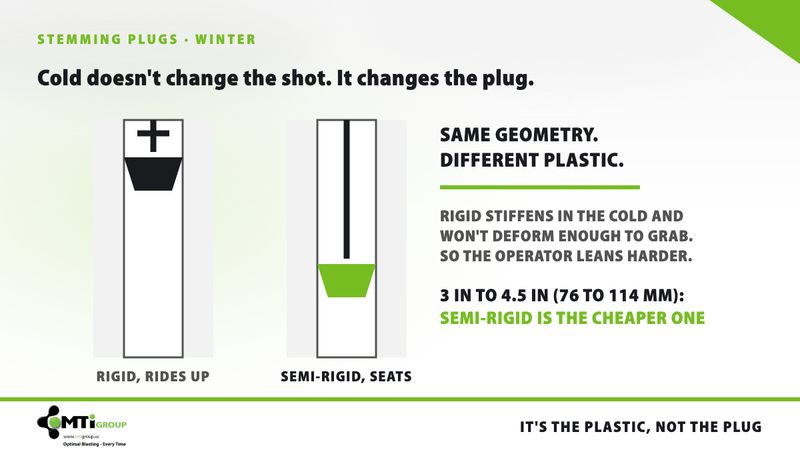
Cold weather blasting: what actually changes
Same plug geometry, different plastic. Here's what changes when the temperature drops, and what a customer said about it.

5 Checks Before You Load a Quarry Hole
The hole your driller left isn't always the hole your crew loads.

Reactive Ground and Hot Holes: Measure Before You Load
Some reactive geology heats itself once oxygen hits the hole, and some Appalachian coal seams have been burning underground for years. Every explosive has a maximum loading temperature, and exceeding...