
Field Guide

Reactive Ground and Hot Holes: Measure Before You Load

3 min read

Some reactive geology heats itself once oxygen hits the hole, and some Appalachian coal seams have been burning underground for years. Every explosive has a maximum loading temperature, and exceeding it can degrade or even ignite the product while you load.

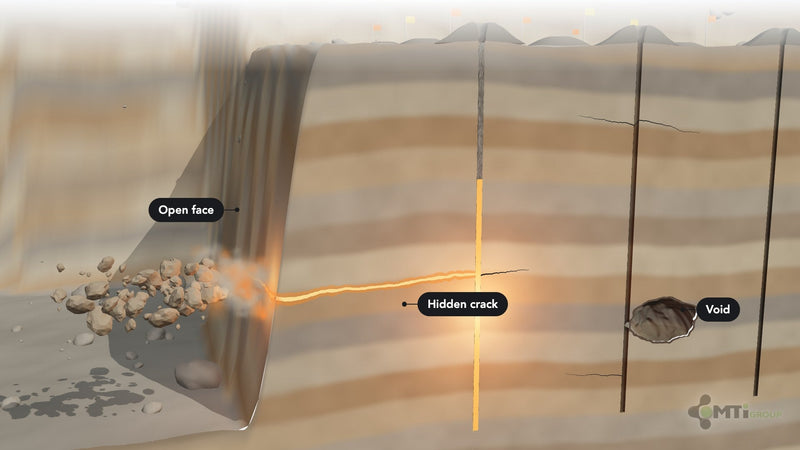
3D bench section: reactive ground heating up round a blasthole and a burning coal seam below, with the temperature probe reading the full length of the hole

Two different conditions produce the same problem: a blasthole that's too hot to load safely.

The two-minute version — reactive ground, coal fires, and the one rule that never changes.

Reactive ground heats itself

Some geologies react with oxygen. Drilling the hole introduces air or water where there wasn't any before. If the rock is rich in unstable sulfides (like pyrite) it begins heating up on its own through a chemical reaction.

The longer that hole sits, the hotter it gets. There's geochemistry here that goes past what a blaster needs to know. What matters operationally is simple: drilled holes in reactive ground get hot, and may keep getting hotter until they're loaded or backfilled.

Hot holes from underground coal fires

This one is an Appalachian story as much as anything, though it shows up in other coal regions too. There are coal seams that have been burning underground for years.

Drill new holes near or through one of those and the holes become extremely hot from close proximity or contact with the fire below. Nothing reactive about it in a chemistry sense. There's just a hot fire underground.

What crews measure with

The right tool is the Blast Hole Temperature Probe, MTi's purpose-built blasthole temperature kit. Plug-and-play, pre-calibrated, and built with the same stainless-cable construction as MITIMEASURE, so it survives the field.

What we've seen crews stuck with instead:

  • Meat thermometers electrical-taped to depth gauges. This may seem unrealistic, but that's what we saw one site use before they finally bought the right tool. Don't do this!
  • Cheap dual-wire thermocouples from suppliers who don't work in blasting. The wires get nicked and cut almost every shot. That leaves you constantly taping and splicing.

For horizontal holes underground, the probe can be pushed down hole with a rigid length of ANFO hose or powder pole, because gravity won't get it there.

What to do with the reading

Below the safe loading temperature: load normally.

Above it: don't load that explosive. Your options are to wait for the hole to cool, which is impractical with reactive ground because it will keep climbing; switch to an explosive with a higher temperature rating; or abandon the area completely.

There is no workaround. Either the hole cools, the explosive changes, or the hole gets left unloaded.

Loading anyway is not an option.

The short version

When in an area with reactive or hot ground, measure the full length of every hole, not just the top and bottom, and not random holes here and there. Check every hole! Check it against the product you're about to load. Then decide.

Working reactive ground or hot seams and want to talk it through? Call us at 606-663-4069.

From the bench

Get the next field guide before you need it.

We write up what we learn from benches like yours — storm protocols, wet holes, lost energy, fragmentation fixes. Two to four emails a month, and you can unsubscribe in one click.
Or browse safety gear