

Field Guide

Development Rounds: Why the Center Has to Go First

3 min read

A development round has no free face, so you have to make one. The bullseye pattern, the firing sequence that fires inward in under a second, and why small-diameter holes change what gear works.

Development round face pattern: arched drift outline with the burn cut in the middle firing first, then easers, walls, back and lifters

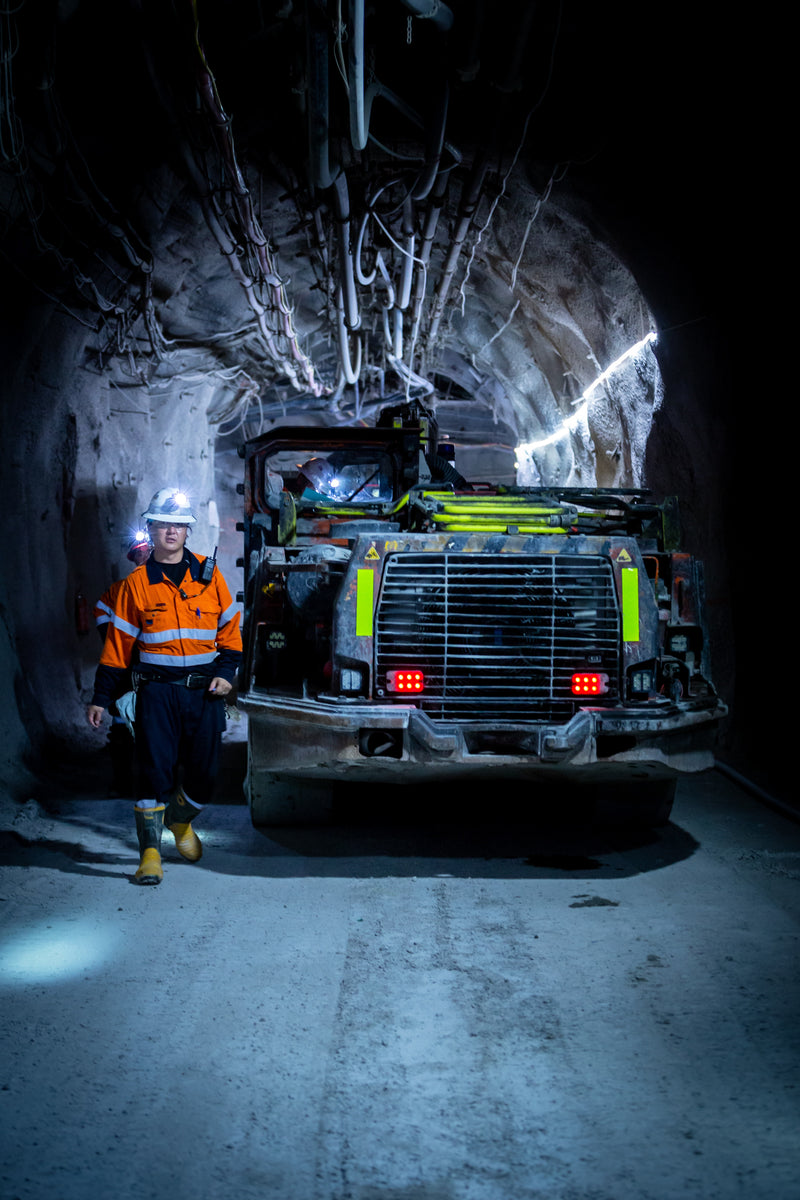
A development round is how a mine builds the tunnel it needs, things like access to an ore body, a ventilation shaft, or a decline you can drive a truck down.

It's drilling and blasting forward to advance a heading, and it's not like production blasting on a bench.
The 70-second version — why the cut fires first, and what fits a small-diameter hole.

The pattern looks like a bullseye

Concentric rings of holes radiating out from a tight cluster at the center. The center holes are spaced closest together, and each ring out is progressively wider. The whole face may carry dozens of holes, all drilled to about the same depth.

The center has to fire first

The blast is timed so the center goes first, creating a void in the middle of the face. Then each successive ring fires inward, collapsing rock toward that void.

The entire sequence fires in less than one second.

Why small diameter changes everything

Development holes run about 1.25" to 5", vs 4" to 12"-plus on a production bench. That has knock-on effects:

  • Bulk loading equipment doesn't always fit, so you may not have bulk anfo or emulsion pumpers.
  • Explosives have to be in cartridge or package form, which means packaged dynamite and cap-sensitive products.
  • Any retention product has to fit inside that diameter.
  • Cartridges have to be pushed to the toe without leaving air gaps between packages.

SPRINGLOCK secures explosive packages in horizontal and up-hole positions inside those small holes.
A Load Pole is what pushes cartridges to the toe and tamps anything in.
Powder Punch safely pokes a hole in the cartridge so that you can insert a cap.

The cycle, and why delays cascade

After the round fires, the muck crew clears the broken rock. Then the roof bolter installs ground support, 3 to 10 ft bolts with large bearing plates and wire mesh, drilled into the back and walls to tie the freshly exposed rock to the competent mass behind it.

Only once the heading is supported does the next round get drilled. A typical round advances 10 to 30 ft depending on geology, hole depth and equipment.

Different crews handle each phase, and each one depends on the crew before it. A delay anywhere cascades through the whole cycle.

Building a ramp instead of a tunnel

In slope mines, also called decline or drive-in mines, the round builds a ramp descending into the earth. The drill boom angles the bottom holes of the pattern downward to create a sloped floor.

The angle can be steepened or shallowed round to round, and turns are navigated by shifting the pattern laterally. The result is a corkscrew ramp very similar to a parking garage, so that vehicles and equipment can drive down to reach the ore body.

How this connects to the ore

Development rounds are how you get to the ore in the first place. A spiral decline is driven downward beside the ore body, and at each target depth horizontal crosscuts are driven into it. Levels are often numbered by depth or elevation, so a 4600 level may be at 4,600 ft underground or 4,600 ft above see level.

Once those access tunnels are complete, long-hole stoping extracts the ore between levels.

The short version

Center first, then rings inward, all inside a second. Small holes, packaged product, and gear that fits the diameter.

Want to talk through what may fit your development rounds? Call us at 606-663-4069.

From the bench

Get the next field guide before you need it.

We write up what we learn from benches like yours — storm protocols, wet holes, lost energy, fragmentation fixes. Two to four emails a month, and you can unsubscribe in one click.

Or browse safety gear