

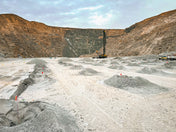
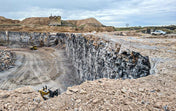
Most winter blasting is the same job you do in July, only hole plugs react differently.
Field Guide
Cold weather blasting: what actually changes
Same plug geometry, different plastic. Here's what changes when the temperature drops, and what a customer said about it.
Rigid plastic gets brittle
Most stemming plugs on the market use rigid plastic. In the cold it stiffens, and a plug that won't flex and won't seat. The operator has to lean harder on the load pole to force it, and below a certain temperature it simply won't deform enough to go in the hole.
A blaster in Pennsylvania told us that on a cold morning, while using an older wooden load pole, he had a rigid plug that wouldn't go down. He leaned into it. The pole snapped and he lunged forward. The jagged, broken pole nearly went through his Carhartt coat. The only thing that prevented this from becoming an abdominal wound.
He has used MTi semi-rigid plugs since and hasn't had the problem again.
Same plug, softer plastic
The MTI semi-rigid Rockrivet is the same geometry in a softer plastic that stays workable when the temperature drops. Same hole ranges, same install, it just remains flexible.
Worth knowing before you order: in the 3 in to 4.5 in (76 to 114 mm) size, the semi-rigid version is the cheaper of the two. In the 4.5 in to 6.5 in (114 to 165 mm) size they're priced the same. There is no cold-weather premium to pay.
Inflatable plugs
An aerosol bag inflates consistently at low temperature. MTi's Blastbag Solo has been in service for years in northern Quebec open pit mining where temperatures reaching -40 F (-40 C) are normal in cold months.
MTi's bags handle cold well. If you only want one bag for winter, the dual-speed aerosol is the strongest choice in the range.
Storage does more than people expect
A lot of cold-weather plug performance is really about how the plug was stored in the hours before it goes in the hole.
Keep stock in a climate-controlled warehouse. If allowed, carry the working stock in the cab of whatever the crew is in, the pickup, the man trip, the drill, the scoop tram, anywhere with heat, until you're ready to use them.
A bag that comes out of a warm cab installs better than one that's been sitting in an open box on the bench for two hours at -20 F (-29 C).
Hands
Wear gloves that still let you load a plug. PU-coated work gloves protect the hands without losing the dexterity the job needs.
A couple of comments from customers
Not a winter story, but the same plug:
"I would first like to thank you, every product I received I am very impressed with and plan on using your products going forward."
"I was very impressed with your hole plugs and rockrivets."
From the bench
Get the next field guide before you need it.
We write up what we learn from benches like yours — storm protocols, wet holes, lost energy, fragmentation fixes. Two to four emails a month, and you can unsubscribe in one click.
More field guides

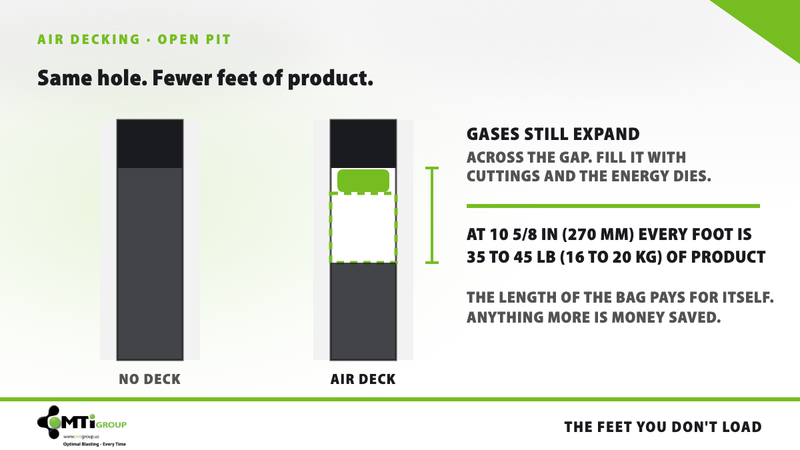
Air decking when you're paying for emulsion
Sites that converted to emulsion this year are paying more per hole. An air deck is how some of them are getting it back.

5 Checks Before You Load a Quarry Hole
The hole your driller left isn't always the hole your crew loads.

Reactive Ground and Hot Holes: Measure Before You Load
Some reactive geology heats itself once oxygen hits the hole, and some Appalachian coal seams have been burning underground for years. Every explosive has a maximum loading temperature, and exceeding...