Field Guide

Managing Wet Holes: What Actually Works

Water in a blast hole isn't an inconvenience — it's a cost. How to find it before you load, and what handles the three wet-hole situations every blaster sees.

Cross-section of a wet blast hole: water in the column over an ANFO charge — MTi Group Managing Wet Holes field guide

Every blaster hits a wet bench eventually.

Groundwater seeps in overnight. A storm fills the column before you can load. Broken ground channels water through cracks that weren't there last shift. You can't always plan for it — but you can have a playbook for when it shows up.

Here's the thing. Water in a blast hole isn't an inconvenience. It's a cost. Dissolved ANFO. Reloaded holes. Stemming that vents instead of holds. All of it shows up on your next fragmentation report — and your next production numbers.
What water actually does to your shot

Water doesn't just get in the way. It goes after the explosive itself.

ANFO can't survive it. ANFO is the cheapest explosive on the market, and it's water-soluble — the prills dissolve, and what's left floats. Load it wet and you get misfires or a low-order shot instead of the 12,000 to 16,000 fps you designed for. Half the velocity isn't half the result — it's orange fumes, oversize, and a toe that didn't pull.

Emulsion survives the water — but not always the hole. Emulsion is the waterproof option, and it's the right call when a hole is full and can't be pumped. It also costs real money. And in wet upholes it has a failure mode of its own: slumping — emulsion dripping back out of the hole, forcing crews to reload two and three times.

And wet stemming vents. Stemming that won't lock against the wall gives the shot a path of least resistance straight up the collar. That's energy venting into the air instead of breaking rock.

Find it before you load

You can't manage water you don't know about. The fix starts before the powder truck shows up: measure every hole.

A depth gauge tells you two things in one drop — actual depth, and where the water sits. The measured depth, not the design depth, is what decides the load. And when you need eyes down there, a blasthole camera shows you instead of making you guess.

Five minutes with a gauge beats an hour of guessing at the loader. Measure first. Then pick your answer.

Three situations. Three answers.

Situation 1: Water's seeping in — or you can pump it out

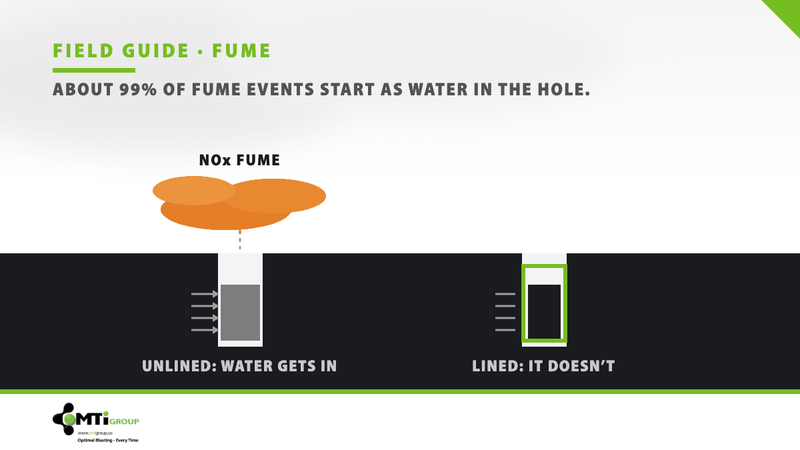
Most crews switch to emulsion here and pay for it on every hole. The cheaper play: line the hole and keep loading ANFO — on a 100-hole shot that can save thousands. BLASTSHIELD™ Plus is a high-tensile ripstop liner with gussets and anti-static carbon strips, proven down to 220 ft. Put a knife cut in it and try to tear it from there — it won't go. For mild damp in smooth holes, an economy poly liner does it for less.

Situation 1 — line the hole with BLASTSHIELD™ and load ANFO inside.

Situation 2: Standing water you can't pump out

Emulsion territory — it's waterproof and sinks where it belongs. The catch: gassed emulsion needs 10 to 30 minutes to gas off, and stemming on an expanding column compromises the shot. BLASTBAG™ AERO is the only bag that can be lowered through water and inflated underwater. Drop it above the column, inflate in 3 to 15 seconds off compressed or mine air, stem immediately. Ships non-DG.

Situation 2 — lower BLASTBAG™ AERO through the water and inflate at depth.

Situation 3: Underground, and the hole won't cooperate

Long-hole stopes mean angled holes, varying diameters, cracks, and breakthroughs — a rigid plastic plug flips, falls out, or never seals. BLASTBALL™ is a nylon-reinforced, tire-strength ball: lower it through water to the exact spot, inflate at 12 PSI, and it conforms to the hole you actually have. Wrong spot? Deflate and reposition. Three sizes cover 2.5" to 8". Every underground gold mine in the US runs them.

Situation 3 — BLASTBALL™ conforms to the hole you actually have.

When one product isn't enough

An underground gold mine in Ghana was losing emulsion to groundwater in upholes up to 26 m (85 ft) long. During monsoon season, inflows doubled. They tried multiple retention plugs. None held.

The fix: line the hole with BLASTSHIELD™ Plus to isolate the emulsion, then hold the liner at the toe with an inflated BLASTBAG™ AERO. Zero slumping or drippage, in a single pass — and the mine has since adopted the combination everywhere water flows are significant. Read the full Ghana case study.

Ready for the next wet bench?

Everything in this guide ships same-day on most orders. If you're not sure which answer fits your bench, call us at 606-663-4069 — we'd rather help you pick right the first time than ship you the wrong product.

And if your wet-hole situation doesn't fit any of these, tell us about it. We build a lot of what we sell because a blaster told us what was missing.

From the bench

Get the next field guide before you need it.

We write up what we learn from benches like yours — wet holes, lost energy, fragmentation fixes. Two to four emails a month, and you can unsubscribe in one click.

Or browse wet hole gear